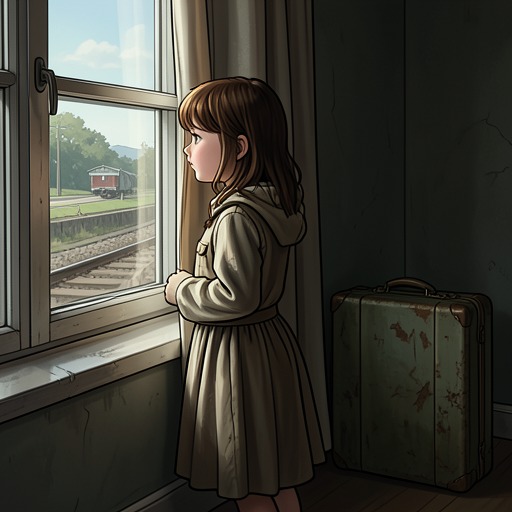
Akari Shinohara
5 Centimeters per SecondAkari Shinohara is Takaki Tohno’s closest childhood companion and first love, a relationship formed through shared displacement and ended, while they are still children, by decisions neither can control. Their years together culminate in a snowbound reunion and a first kiss beneath a cherry tree; later, Akari’s return to an old letter and her attachment to Iwafune show how memories and places can remain part of a life even as it moves forward.
Identity and Childhood
Akari enters Takaki’s life as a new fourth-grade student whose family has moved to Tokyo from Shizuoka. Takaki, who arrived from Nagano a year earlier, recognizes his own unease in her tense stillness at the front of the classroom. In his memory, she wears a pale-pink dress, clasps her hands, and stares ahead with flushed cheeks. That immediate sense of kinship draws him toward her, and they become friends almost at once.
Their friendship rests on a precise sense of being out of step with the world around them. Both are small and prone to illness; both prefer the library to the athletic field and find gym class painful. They favor books, solitude, and long conversations between two people over noisy groups. Akari is the person with whom Takaki can discuss the discomfort of crowded stations, the apparent maturity of classmates raised in Setagaya, and even the unpleasant taste of the tap water. Their families live in separate company housing, but they share part of the route home, and their closeness grows through ordinary time together: lunch breaks, afternoons, and weekends.
A Shared World and Its Fracture
From fourth through sixth grade, Akari and Takaki build a private world around their friendship. They exchange knowledge about the stars, planets, the sky, and distant periods of life on Earth, drawn to things larger and farther away than themselves. Takaki later wonders whether this urgent sharing came from their mutual awareness that another separation might be coming. Both children have already experienced a move; their intimacy is not an assurance that they can stay together, but a way of giving each other pieces of themselves while they still can.
They plan to attend the same private middle school and imagine that their present isolation from classmates will give way to a wider life together. Instead, they are sent to different schools. Akari calls Takaki one winter night in sixth grade to tell him the news. He cannot find words to comfort her, and the awkwardness remains when they part after their graduation ceremony. Akari asks whether this is goodbye; Takaki looks down rather than answering. She is only twelve, and the separation is not her choice, yet he experiences it as an injustice he cannot accept. At the same time, he hopes she will gradually forget him in her new surroundings and thinks he should try to forget her.
Reunion Beneath the Cherry Tree
The separation does not immediately erase their connection. After Takaki learns that his family will move to an island off the coast of Kyushu, he realizes that the distance between them, once manageable by train, may soon make another meeting impossible. He asks Akari to see him before he leaves. They arrange an evening meeting, and he plans his route and the last train home around the chance to spend a few hours with her.
The promised day brings cold rain and a return of winter weather. Takaki carries a letter for Akari in his school bag and spends his classes imagining their conversation and anticipating the sound of her voice. The journey toward her is prolonged by snow and delayed trains, making the meeting feel more precarious as the evening advances. When they finally share a kiss beneath the cherry tree, it is their first. The moment gives physical form to the closeness they have built since childhood, but it also sharpens their awareness that they cannot make a life together simply by feeling that closeness. For Takaki, the kiss brings both a sense of having shared their young lives and an almost unbearable sadness at what lies beyond them.
Iwafune, Marriage, and the Old Letter
As an adult, Akari’s connection to Iwafune has changed from homesickness into belonging. When she first arrives at Iwafune Station from Tokyo with her mother, her father is waiting for them; the small, quiet town is familiar from visits to her grandparents, but living there seems different. Having previously lived in Utsunomiya, Shizuoka, and Tokyo, she feels acutely that she should not be there and nearly cries from missing Tokyo. Years later, Iwafune is her hometown. While preparing to move, she leaves her parents with affection and reluctance, reassuring them that they will see each other at the wedding ceremony the following month.
During the preparations, Akari opens a cardboard box labeled Old Stuff, found deep in a closet. Among school keepsakes, a faded red backpack, and other remnants of childhood, she finds an empty cookie tin and remembers putting Takaki’s letter inside on the night of her middle-school graduation. She had carried the letter in her bag for a long time before putting it away, unable to bring herself to take it out. The recovered letter is not a new communication between them: it is a preserved trace of a moment when she was waiting for Takaki. She reads a little, returns it carefully to its envelope, and decides to keep it until she is older and ready to read it again.
Memory and the Passage of Time
Akari is presented largely through Takaki’s memories and through the objects and places that preserve those memories. Their childhood world is intimate but never insulated from family moves, school arrangements, or distance. The cherry blossoms that once drew them together return as an image in their correspondence and in their reunion, while the letter survives long after the children have gone their separate ways. Akari’s adult life does not erase the attachment; instead, the old letter becomes something she can acknowledge, protect, and set aside while continuing into marriage and a new move. Her arc is therefore not a simple return to first love, but a passage from childhood dependence and involuntary separation toward a life in which the past can be kept without determining every step ahead.